Cushion · What you can absorb · 14 min read
The water's off, or there's a boil notice. Here's what to do.
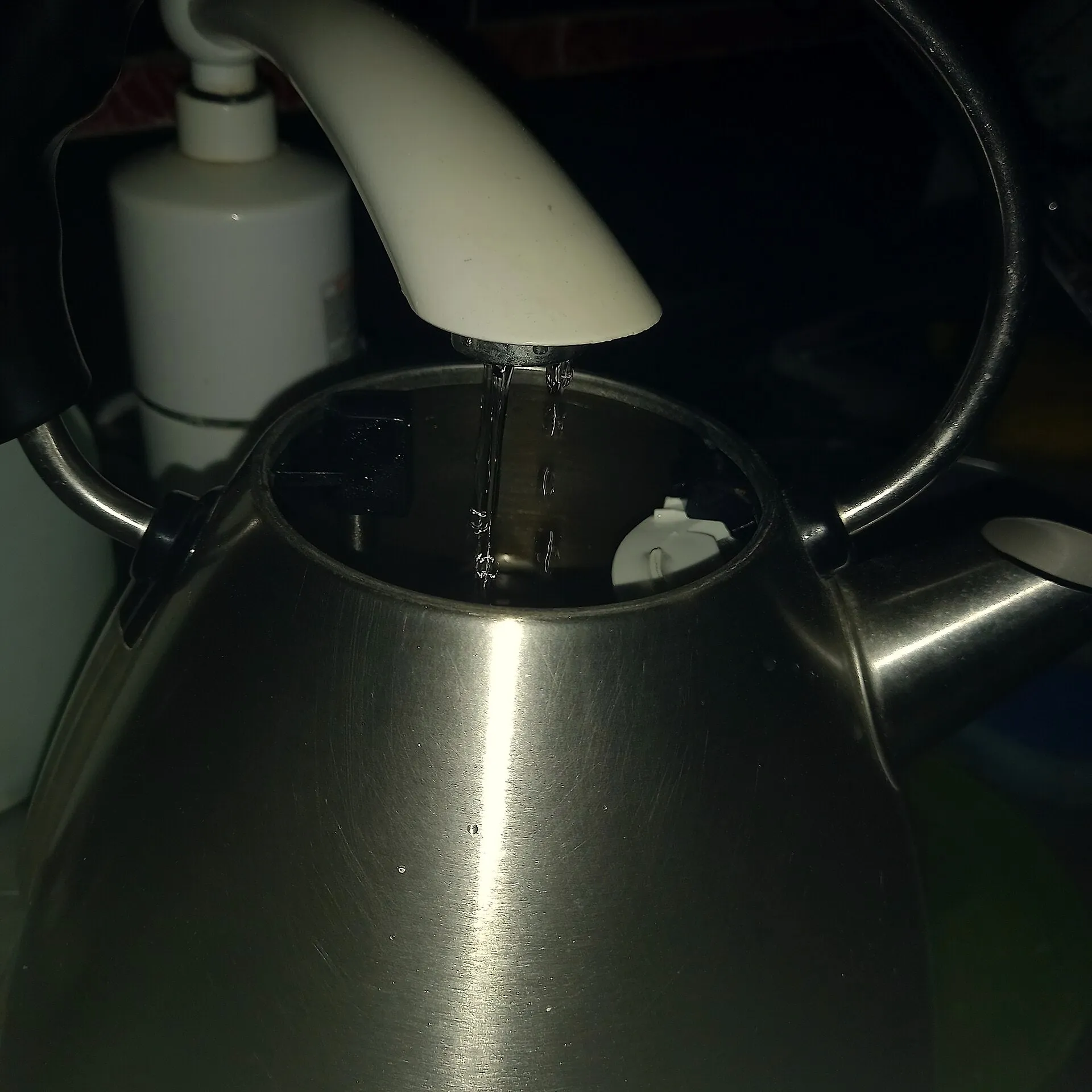

If your water has gone off, check your water company’s website or app first, fill the kettle and a few pans while there is still pressure, and find any stored water. If you have a boil water notice, keep using the tap for washing and flushing, but boil what you drink or cook with. Nobody needs to panic tonight.
First, the calm bit
Short interruptions are ordinary. A burst main, a repair on the network, a pump that needs resetting: most are sorted in hours, and most households never hear about them beyond a text or a van in the street. The long ones, where whole towns go without for days, are rare enough to make the national news.
A boil water notice is a precaution, not a verdict. It means your water company cannot be certain the water is clean enough to drink straight from the tap, so they are asking you to boil it until they can be. Your taps still work. Your toilet still flushes. You can still have a shower.
The first hour
Do these in roughly this order. None takes more than a few minutes.
- Check your water company’s website, app or social media. They will usually post a map of the affected area, a cause and an estimated time for the fix. Not sure who supplies you? It is on your bill.
- If there is still some pressure, fill things. The kettle, saucepans, jugs and bottles for drinking. Then the bath, or a few buckets, for flushing and washing. Lids on anything you plan to drink from.
- Find your stored water and count what you have.
- Check on neighbours who are older, unwell or on their own. The government’s preparedness advice asks households to plan to check in on neighbours in an emergency, particularly anyone with medical needs or who may struggle to get information online. A knock and “have you seen the water’s off?” is enough.
- Tell the children in one sentence. “The water’s off for a bit, the water company is fixing it, we’ve got bottles.”
The first day
If the supply is still off the next morning, the water company should start telling you where to collect bottled water.
Bottled water stations
Usually at car parks, leisure centres or community halls. Bring:
| Bring | Why |
|---|---|
| Proof of address (a bill on your phone is fine) | Some stations check you are in the affected area |
| Bags for life or a box | Multipacks are awkward to carry |
| Your own empty containers | Some stations refill from a bowser or tanker rather than handing out bottles |
| A note of how many people are in the house | Rations are often per household or per person |
Ask about home delivery for people who cannot get to a station. Companies are supposed to look after vulnerable customers first, though as Tunbridge Wells shows below, that does not always go smoothly.
The Priority Services Register
Every water company runs a Priority Services Register. Signing up tells your supplier you need extra support, including when your supply is interrupted. It is free and you can register today, even mid-incident. In Northern Ireland the equivalent is a Customer Care Register; our Priority Services Register guide walks through signing up.
Hygiene without running water
- Hand sanitiser by the loo and in the kitchen.
- Wet wipes, or a bowl of water and soap, for hands and faces.
- A “clean water” jug and a “grey water” bucket, clearly labelled.
- Paper plates and cups if you have them.
Toilets
A toilet will flush if you pour a bucket of water briskly into the bowl. Bath water or rainwater is fine for this; it does not need to be drinking quality. During a boil water notice the DWI says you can “flush the toilet as normal” (DWI, checked 29 August 2026).
There is one situation where the bucket goes back down. If the sewers are affected too and sewage is coming up into your home, CCW’s advice is: “Do not use any water in your home, including flushing toilets or running taps.” That stops the sewage spreading further. Turn off the electricity if it is safe to reach, then ring your water company (CCW, checked 29 August 2026).
Pets
During a boil notice, the DWI advises that water for pets should be boiled and cooled, the same as for people. Bottled water is fine too; keep it fresh.
The first week
Long outages are rare, but it helps to know what one looks like.
What happened in Tunbridge Wells
In late 2025, an event at South East Water’s Pembury water treatment works disrupted supplies across the Tunbridge Wells area. The Drinking Water Inspectorate’s investigation, published on 14 April 2026, puts the scale of it at “up to 60,170 consumers in the Tunbridge Wells area” over November and December 2025, and concludes that “the loss of supply and subsequent boil water notice were foreseeable and preventable” (DWI, checked 29 August 2026).
The DWI did not blame the weather or the raw water. It pointed to longstanding weaknesses in operational management, treatment optimisation, monitoring, maintenance and organisational preparedness at Pembury, said the findings “point to systemic and repeated failings” in both operational oversight and incident management, and placed South East Water into a transformation programme, which it describes as one of the most significant steps the Inspectorate can take (DWI, checked 29 August 2026).
[VERIFY: the day-by-day timeline reported at the time — supply lost 29–30 November 2025, boil water notice issued 3 December and lifted 12 December, and bottled water handed out at sports centres, a cinema and town halls. South East Water’s own incident page did not render for automated checking on 29 August 2026, and neither DWI page gives the dates — check the company’s incident page or its Event Assessment Letters]
The lesson is not “expect the worst”. It is that even the regulator found the incident management wanting, so the support reaching your door may lag the promise on the website, and a few days’ water in the cupboard keeps you out of the queue at 8am.
How much you actually need
The government’s preparedness guidance says a minimum of 2.5 to 3 litres of drinking water per person per day is the survival figure recommended by the World Health Organisation, and that 10 litres per person per day also covers basic cooking and hygiene. For a household of four, plan on around 12 litres a day for drinking and use bath water or the bowser for everything else. The full working, with a household-by-household table, is in how much water per person.
Compensation
Water companies in England and Wales operate under a statutory Guaranteed Standards Scheme, which sets fixed compensation payments when service standards are missed. CCW sets out how it works for supply interruptions (CCW, checked 29 August 2026).
For a planned interruption, the company must tell you in writing at least 48 hours in advance, 24 hours in Wales, and “must restore the water supply by the time stated in the notice, or within 12 hours if it was an emergency due to a leak or burst on a water main”. If it misses that, household customers in England are due £50, and then “an extra £50 (£100 for business customers) for each full 12-hour period that the supply is interrupted or cut off – up to a cap of twice the value of your annual water supply charges”. In Wales the household figures are £20 to start and an extra £10 for each full 24-hour period.
| England | Wales | |
|---|---|---|
| Notice for a planned interruption | 48 hours, in writing | 24 hours, in writing |
| Supply restored by | Time stated in the notice, or 12 hours for a burst or leak on a main | Same |
| First payment (household) | £50 | £20 |
| Then, per further period | £50 per full 12 hours | £10 per full 24 hours |
| Cap | Twice your annual water supply charges | Twice your annual water supply charges |
Figures from CCW, checked 29 August 2026. Payments should be automatic. The Consumer Council for Water represents customers and can help if you feel you have not been treated fairly. [VERIFY: whether South East Water waived the twice-annual-charges cap for the Tunbridge Wells incident, as was reported at the time — Ofwat’s GSS complaint decisions against South East Water (references OFW-043752 and OFW-043213) blocked automated checking on 29 August 2026]
If it’s a boil notice
The DWI puts it plainly: a boil water notice means the water in your tap might contain bacteria, viruses or parasites that could be harmful to your health. Boiling deals with them. For the can-I-shower detail in full, see what tap water is still fine for during a notice.
What to do
- Bring the water to a rolling boil in a kettle or a pan.
- Take it off the heat and let it cool naturally.
- Store it in a clean container, in the fridge.
- Throw it away if it has not been used within 24 hours.
What needs boiled water
According to the DWI, use boiled and cooled water for:
- Drinking
- Brushing teeth
- Making ice
- Preparing food and washing salad or fruit
- Cleaning baby bottles and feeding equipment
- Water for pets
What you can keep doing as normal
The DWI says tap water under a boil notice is still safe for:
- Showering and bathing, as long as it does not get into your mouth
- Washing dishes, if you use hot water and dry them thoroughly before use
- Washing clothes
- Flushing the toilet
Filters, dishwashers, babies and dialysis
The DWI page stops there, so for the questions it leaves open, water companies publish their own boil notice FAQs. Anglian Water’s is the fullest we found, and it is more cautious than the DWI in one or two places (Anglian Water FAQ, reviewed July 2023, checked 29 August 2026). It is one company’s guidance, so if your own company’s notice says something different, follow that.
- Jug and tap filters. Anglian Water says to “seek further advice from the water filter manufacturer as not all domestic filters can be relied upon to remove bacteria”, and if yours cannot, do not rely on it. Treat a filter as no substitute for boiling unless the maker says otherwise, and replace the cartridge once the notice lifts.
- Purification tablets. They “cannot be relied upon to remove the bacteria and the water still needs to be boiled before use”.
- Dishwashers. “Dishwashers are safe to use on programs that heat the water to 70 degrees centigrade for five minutes or more.” Check with the manufacturer whether yours reaches that.
- Washing up by hand. Anglian Water goes further than the DWI here and recommends boiled water for hand washing all dishes, bottles and containers, or at least a rinse in boiled water afterwards. If in doubt, follow your own company’s notice.
- Babies. “Cooled boiled water should always be used for making up baby feeds”, tap water mixed with sterilising tablets should not be used, and “babies should not be given unboiled tap water at any time”. Some bottled water is too high in sodium for infant formula; the label will say.
- Ice, kitchen surfaces and instant-boiling taps. Throw away ice made from unboiled water, use cooled boiled water to wipe food preparation surfaces, and only drink from an instant-boiling tap if it reaches 70°C for five minutes or more.
- Dialysis at home. Anglian Water holds dialysis patients on its Watercare Register and delivers bottled water to them; ring your company to be added, and speak to your dialysis unit about your own situation.
- Open wounds. Use cooled boiled water, and ask your GP about anything specific.
For a health question the FAQ points you to your GP, a pharmacist or NHS 111. [VERIFY: specific boil-notice advice for people with weakened immune systems. Re-checked 30 August 2026: the DWI boil water notice page and Anglian Water’s FAQ still do not treat immunosuppression as a category, and no UKHSA or NHS page setting out boil-notice advice for immunocompromised people could be found. Ask your own water company, your specialist, or NHS 111]
Next time: the 20-minute fix
None of this needs a shed full of supplies. Twenty minutes and a trip to the supermarket will do it.
- Store 9 litres per person. That is three days at the 3 litres a day survival figure. Keep it somewhere cool and dark and swap it at the next big shop; containers, costs and rotation are covered in water storage.
- Write down your water company’s name and emergency number and put it on the fridge. Save it in your phone too.
- Sign up to the Priority Services Register if anyone in the house needs extra support.
- Keep a couple of empty containers with lids for a bowser, plus a bucket for flushing.
- Follow your water company on whichever app you actually open, so updates find you.
That is it. You are now better prepared than most of the street.
What this asks of your body
A water outage is mostly a carrying job. A 9-litre bottled water multipack weighs 9 kg, since a litre of water weighs a kilogram, and a refilled container from a station or bowser weighs a little more, so each trip home is a 10–12 kg carry, possibly up stairs. The five Ready Body tests tell you in ten minutes whether that would be routine or a real problem.
Frequently asked questions
How long does a boil water notice usually last?
There is no fixed length. A notice lifts once the company’s repeated sampling shows the water is safe, in consultation with health authorities; the DWI may investigate afterwards. The Tunbridge Wells disruption ran across November and December 2025 and reached up to 60,170 consumers (DWI, checked 29 August 2026), so plan for days rather than hours.
Can I shower during a boil water notice?
Yes. The DWI says showering and bathing are safe as long as you do not swallow the water. Keep an eye on small children who like to drink bath water.
Can I use tap water for the kettle if I’m boiling it anyway?
Yes. That is exactly what the notice asks. Bring it to a rolling boil, let it cool naturally, and keep it in a clean container in the fridge for up to 24 hours.
Do I need boiled water to wash up?
Not if you use hot water and dry the dishes thoroughly before using them, according to the DWI. For dishwashers, Anglian Water’s boil notice FAQ says they “are safe to use on programs that heat the water to 70 degrees centigrade for five minutes or more” (checked 29 August 2026). Ask the manufacturer whether yours does.
How much water should I keep at home?
The government’s preparedness guidance gives 2.5 to 3 litres per person per day as the survival minimum, and 10 litres for comfort. Three days at 3 litres is 9 litres per person, which is a sensible amount to keep in a cupboard.
Will I get compensation if my water is off?
Probably, if it runs long. CCW says English households get £50 when the company misses its restoration deadline, then a further £50 for each full 12-hour period without supply, capped at twice your annual water supply charges; in Wales it is £20 then £10 per 24 hours (CCW, checked 29 August 2026). Payments should be automatic.
Sources & review
- Get prepared for emergencies, UK Government: water quantities, Priority Services Register, checking on neighbours. Checked 29 August 2026.
- Receiving a boil water notice, Drinking Water Inspectorate: what a notice means, how to boil, what needs boiled water, what tap water is still fine for, and “flush the toilet as normal”. Checked 29 August 2026.
- Boil water notice frequently asked questions (PDF, reviewed July 2023), Anglian Water: filters, purification tablets, dishwashers at 70°C for five minutes, washing up by hand, baby feeds, ice, kitchen surfaces, instant-boiling taps, dialysis patients, open wounds and pets. One company’s guidance, not national policy, so follow your own company’s notice where it differs. Checked 29 August 2026.
- Boil notice for customers in Tunbridge Wells, South East Water: the company’s own page for the 2025 incident. The page would not render for automated checking on 29 August 2026, so nothing here rests on it.
- Drinking Water Inspectorate investigating South East Water incident, DWI, 4 December 2025: confirms the event affecting supplies in the Pembury and Tunbridge Wells area, the boil water notice, and the full water quality investigation. It gives no dates or property count. Checked 29 August 2026.
- South East Water, Tunbridge Wells investigation conclusion, DWI, published 14 April 2026: up to 60,170 consumers affected, the loss of supply and boil water notice were foreseeable and preventable, the failings found at Pembury, and the transformation programme. Checked 29 August 2026.
- What standards are guaranteed by water and sewerage companies?, CCW: the Guaranteed Standards Scheme notice periods, restoration deadlines, and the £50 / £50 per 12 hours England and £20 / £10 per 24 hours Wales household payments, capped at twice annual water supply charges. Checked 29 August 2026.
- Sewer flooding, what to do if your home is affected, CCW: “Do not use any water in your home, including flushing toilets or running taps.” Checked 29 August 2026.
- Consumer Council for Water: the consumer body for water customers, and where to complain if a company will not pay. Checked 29 August 2026.
Reviewed by: TBC. Review date: 29 August 2026. Three [VERIFY] tags remain: the Tunbridge Wells day-by-day timeline, whether South East Water waived the compensation cap, and boil-notice advice for people with weakened immune systems.